



Frequently Asked Questions
Welcome to our sustainability FAQs page. From reducing environmental impact to improving responsible sourcing, this FAQ covers the most common questions about how we’re working towards a more sustainable future. Scroll down the page or use the filters below to explore.
Filter FAQs
Sort by

Alphabetical (A - Z)
Alphabetical (Z - A)
All Categories
Agriculture
Carbon
Energy
Environment
People
Policies
Sustainable Sourcing
Targets
Water
Targets
What are your SBTi targets?
16th January 2026

In January 2024, ABF Sugar (ABFS) announced the approval of its near, and long-term science-based emissions reduction targets with the Science Based Targets initiative (SBTi). This milestone demonstrates our proactive approach to addressing climate change and mitigating its impacts through our actions.
ABFS is committed to reducing E&I (scope 1 and 2) emissions by 52.1% by 2030 and to a net-zero reduction target of 90% by 2050. Additionally, they aim to reduce scope 3 emissions by 30% by 2030 and 90% by 2050.
They have also committed to reducing FLAG emissions from owned (scope 1), purchased sources (scope 2), and indirect sources (scope 3) with a near-term reduction target of 36.4% by 2030.
Additionally, they have committed to a net-zero reduction target of 90% by 2050 for scope 1 and 2 emissions and 72% reduction for scope 3 emissions by 2050 through collaboration with our stakeholders.
British Sugar as one of the ABFS businesses will contribute towards the validated targets and our trajectory is set out in our current transition plan (see question below).
What is your transition plan?
19th January 2026
Our transition plan features in ABF’s Climate-related Financial Disclosures (TCFD).
For British Sugar, we are working towards reducing greenhouse gas emissions (GHG) for Scope 1 and 2, Energy & Industry (E&I). With a focus on three areas - energy efficiency, fuel switching and investment in new technology.
In the short term, we will continue to deliver projects focusing on factory energy efficiency / steam reduction, coal elimination and reduction of energy use for pulp drying.
In the long term, our focus will be on technological advancements for factory energy efficiency / steam reduction and alternate pulp drying technologies.
Since our 2018 baseline year, British Sugar has invested approximately £134m in 52 energy efficiency and carbon reduction projects, resulting in a cumulative reduction of above 160kt of CO2e.
In addition, we have reduced our Scope 1 and 2 market-based GHG emissions by 31%, achieved a 13% reduction in energy used (excluding energy exported, and achieved a 31% reduction in water abstracted (+ municipal).
We have also eliminated coal as a fuel source across our factories.
Sustainable Sourcing
Can you track where you’ve sourced raw material from (country and type of sugar - raw or beet)?
12th January 2026
Yes, we have a sourcing map and a central tracker for all bought in sugars. We know what is sugar beet and what is sugar cane. You can view our sourcing map by clicking the link below.
Please get in touch with your account manager if you have further questions regarding this.
Does your company have a formal, written Supplier Code of Conduct policy that specifically holds your suppliers to account for social and environmental performance?
19th January 2026
As a business of ABF PLC, we ask all our suppliers to adhere to the ABF Supplier Code of Conduct which can be found on ABF's website.
What methods do you follow for third party certification of sugar?
19th January 2026
All British Sugar manufacturing sites are accredited to ISO 14001 for Environmental Management Systems (EMS) and ISO 50001 for Energy Management Systems (EnMS).
All our sugar beet growers must ensure that their sugar beet crop is audited under the Red Tractor Farm Assurance (Combinable Crops and Sugar Beet Standard) Scheme at all times. This assurance scheme, when benchmarked with UK legislation, achieves Sustainable Agriculture Initiative (SAI) Platform Farm Sustainability Assessment (FSA) 3.0 Silver Level Equivalence.
All sugar beet delivered to our factories must have a certification number for us to process. In addition, our Bury St Edmunds factory is also Red Tractor assured, and we are audited yearly on this.
Please get in touch with your account manager if you need proof of certification.
Do you purchase palm oil for use across your operations?
19th January 2026
We do not use palm oil at British Sugar.
All the sugar, thick juice, molasses, and sugar specialities manufactured on British Sugar’s sites are free from palm oil and its derivatives.
Carbon
What is your carbon SBTi target?
7th May 2026
British Sugar is part of ABF Sugar, and our actions contribute towards their validated SBTi targets.
They are committed to reducing E&I (scope 1 and 2) emissions by 52.1% by 2030 and to a net-zero reduction target of 90% by 2050. Additionally, ABF Sugar aims to reduce scope 3 emissions by 30% by 2030 and 90% by 2050.
This includes emissions from purchased goods and services, capital goods, fuel and energy related activities, upstream transportation and distribution, waste generated in operations, business travel, employee commuting, and downstream transportation and distribution.
How do you plan to achieve your SBTi carbon targets?
5th January 2026
We contribute towards ABF Sugar's validated SBTi targets by focusing on three areas - energy efficiency, fuel switching and investment in new technology.
In the short term, we will continue to deliver projects focusing on factory energy efficiency / steam reduction, coal elimination and reduction of energy use for pulp drying.
In the long term, our focus will be on technological advancements for factory energy efficiency / steam reduction and alternate pulp drying technologies.
You can read more about our transition plan by clicking the link below.
What is the total carbon footprint of your business?
6th January 2026
Our total carbon footprint will change every year because there are several contributing factors including sugar beet crop size, factory processing days, along with initiatives to continue our decarbonisation efforts at factories.
For our most recent reporting year of 2024/25, our greenhouse gas emissions were as follows: Scope 1: 714,939 tCO2e, Scope 2: 4,206 tCO2e
What is your product carbon footprint (PCF)?
7th January 2026
Our sugar product carbon footprint is 620kg CO2e/tn sugar product.
We also have PCFs for our co-products which are available upon request through your customer account manager.
What is the emissions split across your operations?
8th January 2026
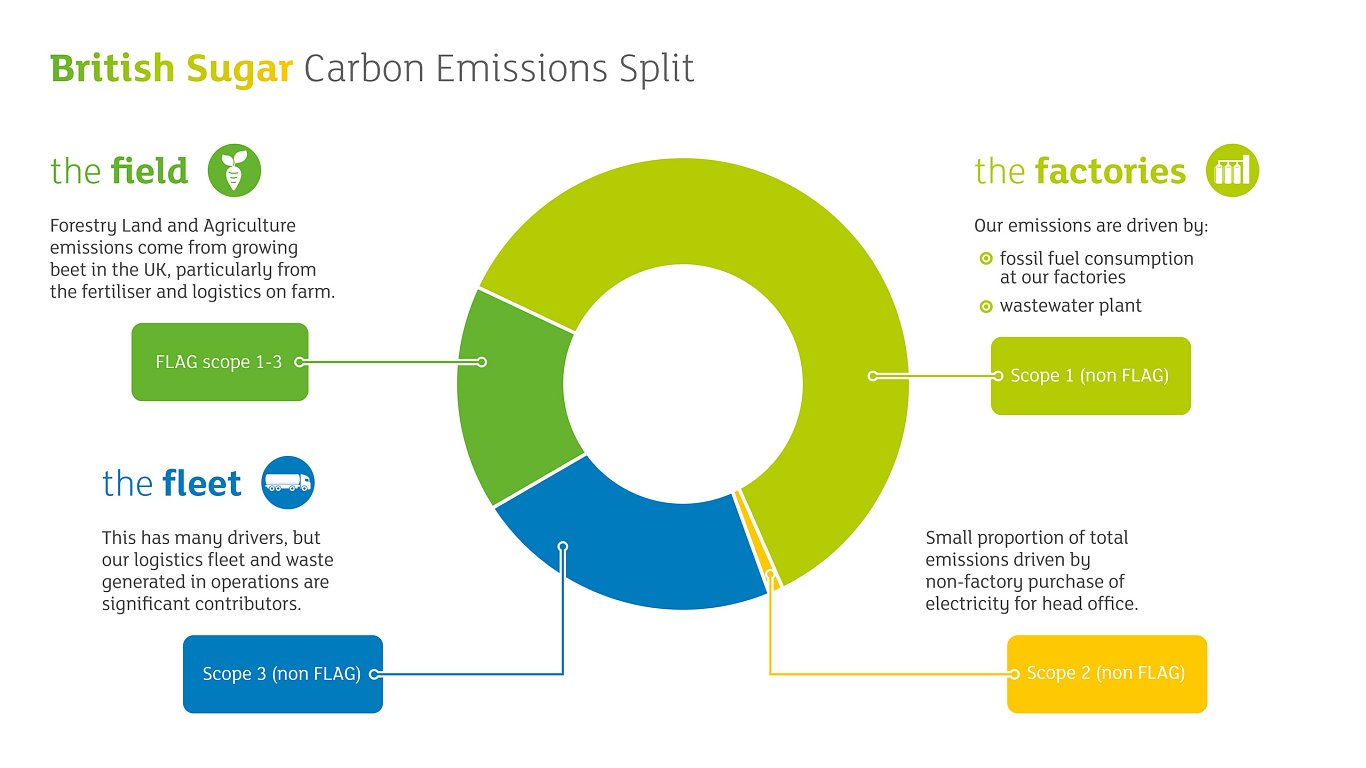
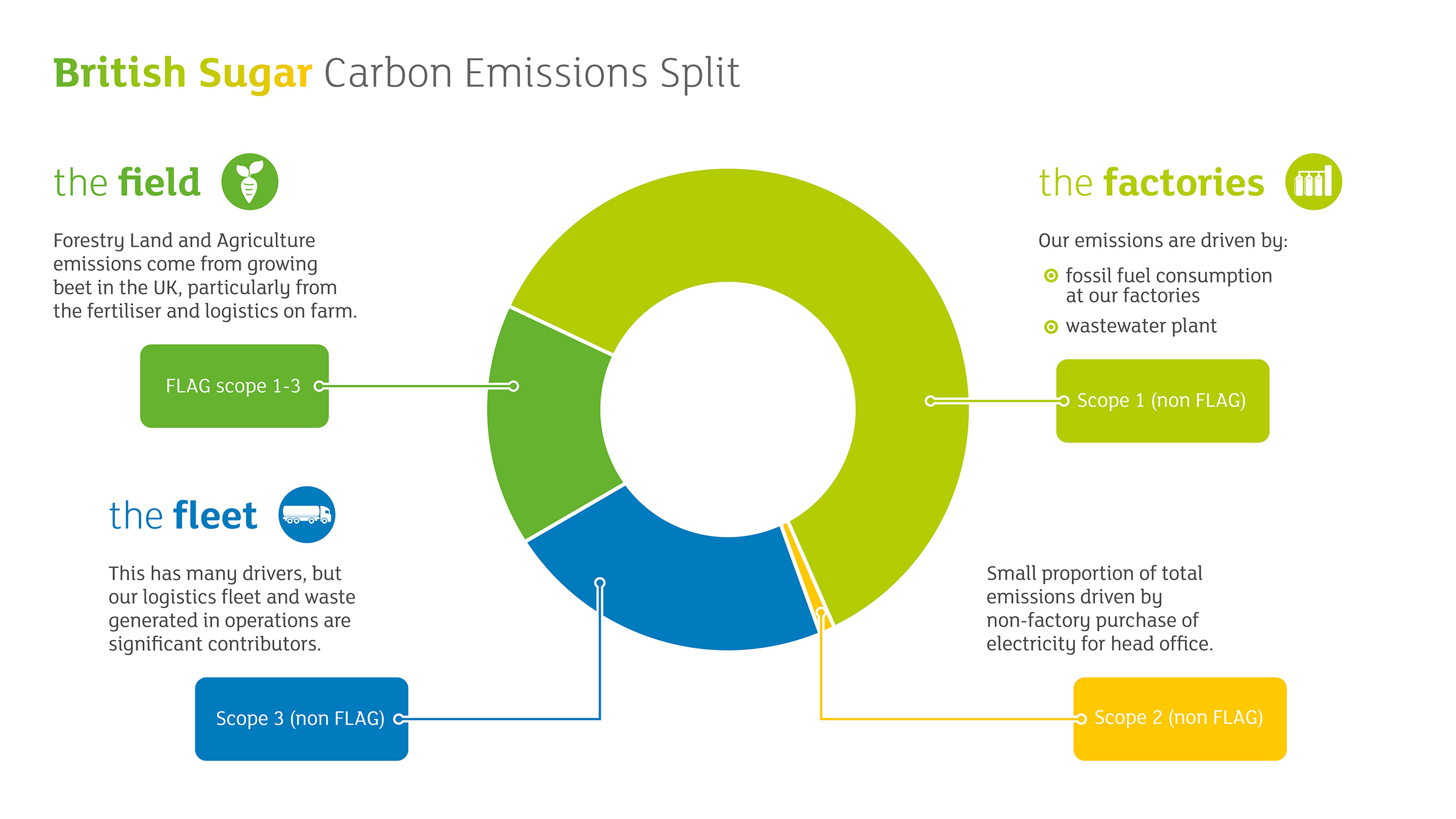
Most of our carbon emissions come from our factory operations (Scope 1), followed by our inbound and outbound transport fleet (Scope 3 - non-FLAG), and activity in the field (FLAG Scope 1-3).
See graphic below which displays our emissions split.


Can you split cultivation vs processing emissions (split per tonne of sugar)?
9th January 2026
Yes, we have the breakdown of emissions sources by source within British Sugar, which we update annually in line with ABF financial year-end reporting.
If you’d like to know more, please contact your account manager.
Do you participate and publish CDP reports?
10th January 2026
As a business owned by ABF, we contribute towards their CDP reporting which is published annually on their website.
You can read ABF’s 2025 CDP Corporate Questionnaire by clicking the link below.
Energy
What is your overall energy usage?
13th January 2026
For the year 2024/25, we used 338MWh/100tn sugar produced.
This equates to a total energy used of 3,662,371,326 KWh.
How do you power your operations?
19th January 2026
All our factories operate Combined Heat and Power (CHP) plants, utilising natural gas as the fuel option which maximises fuel efficiency conversion into energy.
We export excess electricity generated to the national grid at all four sites, most significantly at our Bury and Wissington sites.
All of our imported electricity is renewable through the REGO scheme.
Agriculture
How much sugar beet do you source on average every year?
1st January 2026
Around eight million tonnes of sugar beet every year is sourced from across the beet growing region which consists of East Anglia, the East Midlands and Yorkshire.
The exact tonnage will differ year-on-year because of many factors, including but not limited to climate or weather conditions, contracted hectares, or market demand.
Which tool / program is used for this farm assessments?
2nd January 2026
In Spring 2026, we announced a new collaboration with the Soil Association Exchange (SAX) for UK sugar beet growers. The specific offering we have created with SAX for sugar beet growers will enable them to earn payments for actions to reduce greenhouse gas emissions, improve the environmental performance of the crop, and support the long-term resilience of farm businesses. SAX measures and rewards sustainability improvements using measurements across six key areas including soil, water, biodiversity, and carbon. For more information on our work with SAX, please click the link below.
In addition, all our sugar beet growers must ensure that their sugar beet crop is audited under the Red Tractor Farm Assurance (Combinable Crops and Sugar Beet Standard) Scheme at all times. All sugar beet delivered to our factories must have a certification number for us to process. In addition, our Bury St Edmunds factory is also Red Tractor assured, and we are audited yearly on this.
This assurance scheme, when benchmarked with UK legislation, achieves Sustainable Agriculture Initiative (SAI) Platform Farm Sustainability Assessment (FSA) 3.0 Silver Level Equivalence. This alignment helps ensure that our sugar beet supply chain meets internationally recognised sustainability expectations and supports transparency for customers seeking globally benchmarked sustainable sourcing standards.
We are also proud to be founding members of SAI Platform’s Regenerative Agriculture Programme – a collaborative and farmer-centred initiative that aims to address the urgent need for an aligned industry recognised, trusted and cost-effective way to assess, measure and report regenerative agriculture outcomes.
How do you work with growers to consider best IPM practices?
3rd January 2026
British Sugar and UK sugar beet growers jointly fund the British Beet Research Organisation (BBRO) who conduct research and trials on behalf of the homegrown sugar industry. Part of this work is looking into the best integrated pest management (IPM) approaches.
Currently IPM research is looking into the use of cover crops, odours and coloured dyes and beneficial hosts to understand the impact these methods have on the sugar beet crop. Particularly in relation to the limiting pests and diseases such as Virus Yellows disease which poses the biggest risk to the crop.
You can read more about our Virus Yellows Pathway, including our ongoing gene editing project by clicking the link below.
Water
What is your total water footprint and the footprint of your operations?
17th January 2026
Over the course of 2024/25, total water abstracted, including municipal, for all our operational sites was 2,099 km3.
This equates to a 31% reduction in water abstracted (+ municipal) since the 2018 baseline year.
What are your reduction targets and improvements plans?
19th January 2026
British Sugar has invested over £20 million since 2022 to further improve the quality of water discharged from its sites. This includes two new water treatment plants at Cantley and Newark, as well as upgrading existing facilities at our other locations.
We treat all water used on site before discharging into the environment, as required by our environmental permits. Our sites return more water into the catchment area, than they consume, as we use the water contained in the sugar beet crop (circa 75%).
We have a project in construction at our largest site, Wissington, which will enable a reduction in our abstracted water once fully operational.
To find out more about our water usage, please click the link below.
Environment
Do you abide by environmental permits?
14th January 2026
All our sites are regulated by the Environment Agency through an environmental permit and we receive regular audits throughout the year.
We have an Environmental Management System (EMS) covering our business and are certified to ISO 14001.
Do you track and report against the amount of waste produced/packaging used?
19th January 2026
All our sites have a waste management system, which is a structured process for managing and handling waste onsite through to collection, transport, recycling or final disposal; whilst minimising the environmental impact through reduction, reuse and recycling.
We measure waste and report less than 200g per tonne of sugar produced.
Do you have any initiatives in place to reduce waste / packaging?
19th January 2026
We recently invested £20m at our Bury Customer Supply site which has transformed the site’s capability to pack, palletise and distribute sugar to Silver Spoon for their retail customers.
New and refurbished packing machines, alongside palletisation equipment has increased the capability and flexibility of the site, alongside a significant re-design of retail and shelf ready packaging.
This transformation work has delivered a significant reduction in terms of environmental impact. From removing single use labels completely, to achieving over 60% plastic reduction as cardboard now has a greater use within the product packaging mix, and over 45% reduction in brown and white paper waste on site. Additionally, the project is expected to deliver carbon reductions attune to 229 tonnes of CO2e and a reduction of 470 tonnes of water per annum over the coming years.
In addition, we are fully compliant with the extended producer responsibility (EPR) regulations regarding product packaging and the plastic packaging tax. We have also recently updated some of our bagged product to recyclable paper sacks for 20kg and 25kg formats.
What co-products do you produce as a result of the sugar production process?
19th January 2026
The sugar-making process creates a range of co-products, which enable us to drive efficiency, develop our sustainability performance and work across multiple industry sectors.
These include, but are not limited to aggregate, animal feed, betaine, bioethanol, electricity/renewable energy, LimeX (soil pH corrector), raffinate, specialist pharmaceutical ingredient, topsoil and vinasse.
To find out more about some of our co-products, please the link below.
People
Do you pay employees living wages?
11th January 2026
At British Sugar, we are committed to providing competitive and fair pay structures that attract, engage, and retain high quality talent. Our compensation framework is reviewed annually to ensure it remains appropriate to the prevailing economic climate and aligned with our strategic objectives.
British Sugar has made a clear commitment to pay above the National Living Wage. This commitment is set out in our National Living Wage statement and is evidenced through an annual review of all pay elements. Where appropriate, we apply the Anker Methodology to better understand living wage considerations, identify any potential pay risks, and ensure that appropriate action plans are in place to address them.
Do you report your gender pay gap metrics?
19th January 2026
Every year we publish our gender pay gap report which details all our metrics, actions and activities that have contributed towards our results.
Our 2025 report detailed the significant steps towards supporting narrowing our pay gap through a broad range of Inclusion & Diversity initiatives. This is a long-term strategy where year-on-year we see a shift in our results.
To read our gender pay gap report, click the link below.
What training practices have you got in place and what metrics do you measure against?
19th January 2026
Health and Safety training data is an aggregate of onboarding, job fundamentals and leadership training. In 2025, we introduced a new unified Learning Management System (LMS) with clear governance and visibility on scorecard.
The majority of 'training hours per employee' and % employees given skills or career related training takes place over the summer months, in the maintenance period outside of harvesting campaign.
Do you have grievance mechanisms in place for staff?
19th January 2026
Yes, we have a Grievance Policy and Procedure in place for all our employees, and we also have whistleblowing through our Speak Up Policy which aligns to the ABF Policy.
All individuals working for British Sugar and third parties are welcome to use any of the reporting channels set out in this Policy.
Do you have a modern slavery and human rights statement?
19th January 2026
As a business owned by ABF, the ABF Supplier Code of Conduct and Modern Slavery and Human Trafficking Statement supports our approach to human rights.
To view the Modern Slavery Statement, as well as our own human rights policy, please click the links below.
Are you SEDEX SMETA compliant?
19th January 2026
Yes, SEDEX SMETA audits across all sites take place on a three-year cycle (except for Bury St Edmunds which is on a two-year cycle).
Our Bury St Edmunds site had a SMETA 7 audit in November 2025 (FY24-25) and all other sites are due to be audited in Autumn 2026.
How do you demonstrate responsible recruitment in line with the ETI Basecode?
19th January 2026
We do this by ensuring that all recruitment of British Sugar colleagues is undertaken in line with our British Sugar Recruitment and Pre-Employment Policy and Procedures.
British Sugar recognises that it is illegal for employers, contractors and recruitment agencies to charge workers for finding them a job. The costs of all recruitment should be paid by the employer, not the job seeker as defined under the Employer Pays Principle (EPP). British Sugar by recognising the EPP, affirms that no worker should pay for a job and that the costs of recruitment should be borne not by the worker but by the employer.
Also ensuring that all of our labour providers have signed our Procurement Responsible Sourcing Policy before being able to provide any labour to the business.
Policies
Where can I find copies of your policy documents?
12th May 2026
You can find copies of all our policies by clicking the link below.
Do you have a deforestation policy?
15th January 2026
We have a statement on EU Deforestation Regulation (EUDR) for British Sugar (which excludes Silver Spoon), please see below.
Following a review of the EU Deforestation Regulation (EUDR) and its scope, we can confirm that products British Sugar supplies (either sold in or exported from the EU) are currently out of scope and do not fall within the list of commodities or products which EUDR covers. Please note that this statement and scope does not include Silver Spoon products, which have separate trading arrangements.
We appreciate the growing interest in the EUDR and its role in promoting sustainable and deforestation-free supply chains. As a responsible UK-based food manufacturing business, we fully support initiatives that aim to protect global forests and biodiversity. We continue to monitor regulatory developments and maintain transparency with our customers and partners. If our business activities change in a way that brings our products within scope of the EUDR, we will update our position accordingly.
British Sugar remains committed to responsible sourcing and environmental stewardship across our operations including sourcing FSC certified wood/paper products.
If you have any further questions or require clarification, please don’t hesitate to contact us.
What certifications do you adhere to across your operations?
19th January 2026
ISO standards (14001, 45001, 50001)
SMETA, SEDEX
Sustainable Agriculture Initiative (SAI) Platform Farm Sustainability Assessment (FSA) 3.0 Silver Level Equivalence
Red Tractor Farm Assurance (Combinable Crops and Sugar Beet Standard) Scheme
FSSC 2000
EcoVadis (re-awarded GOLD in April 2026)
Royal Warrant of Appointment by The King
Fairtrade
Bonsucro
Vive
If you require evidence of certifications, please contact your account manager.

Registered in England
No. 315158 at Weston Centre
10 Grosvenor Street
London W1K 4QY